
Historical Ship Models: Achieving Authenticity and Overcoming Kit Limitations
Historical Ship Models: Achieving Authenticity and Overcoming Kit Limitation
Building a historical ship model is a journey through time. However, for many modelers, this journey ends at the limitations of commercial kits. At HiSModel, we believe the difference between a “built model” and a “historically accurate replica” lies in details supported by real research. Our ship model accessories are not just add-ons, but the result of hours of archival research and precise digital modeling.
Limitations of Commercial Kits
Most mass-produced kits suffer from compromises that will eventually limit any experienced modeler. Our parts are designed to enable top-tier upgrades of ship models from manufacturers such as Revell, Heller, Mamoli, Amati, Corel, or Mantua:
- Plastic kits: Their biggest weakness is the material itself and the execution of details. Rigging elements, cannons, and small accessories are often crude, historically inaccurate, and lack proper scale finesse. Plastic can never fully replicate the natural structure of wood and metal.
- Wooden kits: Here we often encounter inconsistent wood quality and simplified construction. Execution is frequently subpar, and details are sacrificed for ease and cost efficiency in mass production. Manufacturers aim to simplify the building process as much as possible, often at the expense of historical accuracy.
Both types of kits also tend to ignore the fact that ships underwent multiple reconstructions during their service lives, and their appearance changed over time. Kit manufacturers rarely account for these aspects and often use generic parts that do not correspond to a specific nation, technological stage, or historical period of the vessel.
Our Sources: From General Knowledge to Original Plans
Our primary specialization is historical ship rigging. In its design, we rely on recognized “bibles” of naval history:
- James Lees: The Masting and Rigging of English Ships of War – a key source for British rigging.
- David Steel: The Elements and Practice of Rigging and Seamanship – for understanding historical seamanship and rope handling.
- Lennarth Petersson: Rigging Period Ship Models – for detailed understanding of rigging structures.
- Jean Boudriot: The Seventy-Four Gun Ship and other publications by ANCRE.
While this literature provides a solid technical foundation, for our sets for specific ships (such as Victory, Constitution, Sovereign of the Seas, or Utrecht), we go even further. We study historical ship plans from naval archives to ensure that our accessories match a specific vessel at a precise historical moment and configuration.
Comprehensive Approach to Detail
We apply the same level of attention to all other elements of the model. For decks, we use knowledge of historical construction methods, plank layout, and thickness. For flags, cannons, and other accessories, we study period heraldry and artillery metallurgy. Our goal is to bring historical accuracy even to the smallest components that standard kits lack.
Blocks: British vs. Continental Types
A good example of our expertise is the classification of rigging blocks. We offer standard wooden blocks for models in two fundamental shapes that defined the national identity of a ship:
- British type: Characterized by a more angular and pronounced profile, typical for the Royal Navy from the 18th century onward, later spreading into merchant fleets and the rest of Europe.
- Continental type: More rounded in shape and widely used by European fleets from the 16th century until the mid-18th century (including British ships during that period).
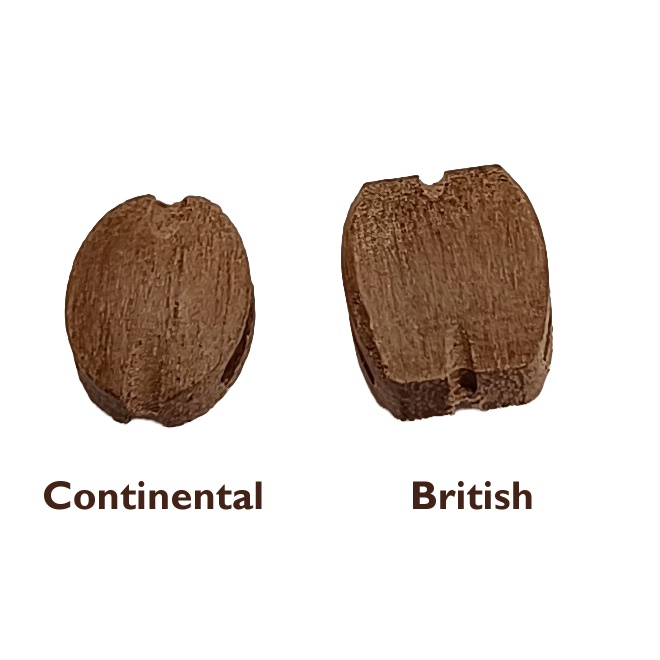
We do not produce only universal shapes, but also specialized types such as sheet blocks, pendant blocks, or fiddle blocks. We apply the same precision to the production of cannons and carriages, where we reflect historically accurate shapes based on period drawings.
Support for Your Build: Rigging Maps and “Easy” Sets
We understand that a pile of small bags without clear identification is not helpful. That is why ship plans are available on our website. For all our block sets, we provide detailed plans where each component is clearly marked by type and size, including its exact placement on the model.
For selected flagship models, we also offer “Easy” sets (simplified block or sail sets). These are intended for beginners or less advanced modelers who want to achieve a high HiSModel standard with a less complex building process.
From History to Reality
Our accessories are not just pieces of wood or metal. They are the result of digital modeling based on hours of archival research. When you replace a plastic cannon or a generic block with our component, you are not just improving aesthetics – you are restoring the historical identity of your model. To ensure a smooth purchasing experience, we also recommend reviewing our shipping information.